
Stephens Release Supervision Types
A person outside a jail or prison may still be under legal supervision. In Stephens County, the source of that authority determines where to verify it. The Texas Board of Pardons and Paroles decides whether an eligible state prisoner receives parole. TDCJ Parole Division then provides day-to-day supervision for parole and mandatory supervision. A trial court orders probation, which Texas law calls community supervision, and the Stephens/Young County Community Supervision and Corrections Department administers it locally.
Physical release and supervision are separate events. A probation order does not prove the hour someone left the Stephens County Jail. Likewise, a parole approval does not prove that a person has departed a TDCJ unit. The actual jail movement sheet or TDCJ release record confirms departure.
| Question | Parole or mandatory supervision | Probation |
|---|---|---|
| Who authorizes it? | Texas Board of Pardons and Paroles under state-sentence rules | The sentencing court |
| Who supervises? | TDCJ Parole Division | Stephens/Young County CSCD |
| Where to verify? | TDCJ IVSS, Board status line, and assigned parole office | Court docket and local Adult Probation |
| What proves release? | An actual TDCJ release date or certificate | The jail release record when custody came first |
- Parole
- Conditional release from prison while the sentence continues under supervision.
- Mandatory supervision
- A statutory supervised-release path for an eligible person based on calendar and good-conduct time, with applicable Board review.
- Probation
- Court-ordered community supervision administered by a local CSCD.
- Discharge
- The formal end of a sentence or supervision term.
Verify Stephens Post-Release Supervision
Begin with the sentence source, not a guess based on residence. Someone convicted in another county can reside under parole supervision in Stephens County. A person convicted locally might report elsewhere after an approved move. Search by TDCJ or state identification number when possible because a shared name can lead to the wrong record.
- For a state sentence, search the TDCJ IVSS offender record. Match the name, TDCJ number, state ID, offense, and county.
- Read status first. “Under Supervision” supports an active TDCJ community status. “Out of Custody” must be read with release history. “Unsupervised Custody” is separate.
- For a pending parole review, call the Board status line at 1-844-512-0461 for the review stage, last decision, and next review date.
- For probation, obtain the court order and confirm assignment with Stephens County Adult Probation.
- Confirm the reporting office before travel because an approved residence can move a parole assignment.
The Stephens County released inmate search explains how to confirm physical release before tracing supervision. That order matters. A person can leave one custodian yet transfer to another, and an order may exist before release processing is complete.
Important: A projected date, favorable parole vote, or probation order is not an actual release event. Verify departure with the holding agency.
Stephens Release Offices Split
Stephens County has an important administrative split. TDCJ assigns the county to the Mineral Wells District Parole Office in Region II. Adult Probation is based at the Stephens County courthouse and works within the shared Stephens/Young CSCD structure. These offices do not exchange roles simply because both deal with people living in the community after a criminal case.
Mineral Wells District Parole Office
999 Cross Post Road
Mineral Wells, TX 76068
Phone: 940-325-7811
Fax: 940-325-9732
Stephens County Adult Probation
200 W. Walker
Breckenridge, TX 76424
Phone: 254-559-9581
Ask each office only about the function it controls. Parole staff address TDCJ assignments. Adult Probation addresses local community-supervision cases. The court clerk supplies the order, while the jail or TDCJ supplies the physical release record.
The official TDCJ Parole Division overview shows why state parole supervision is not county probation.
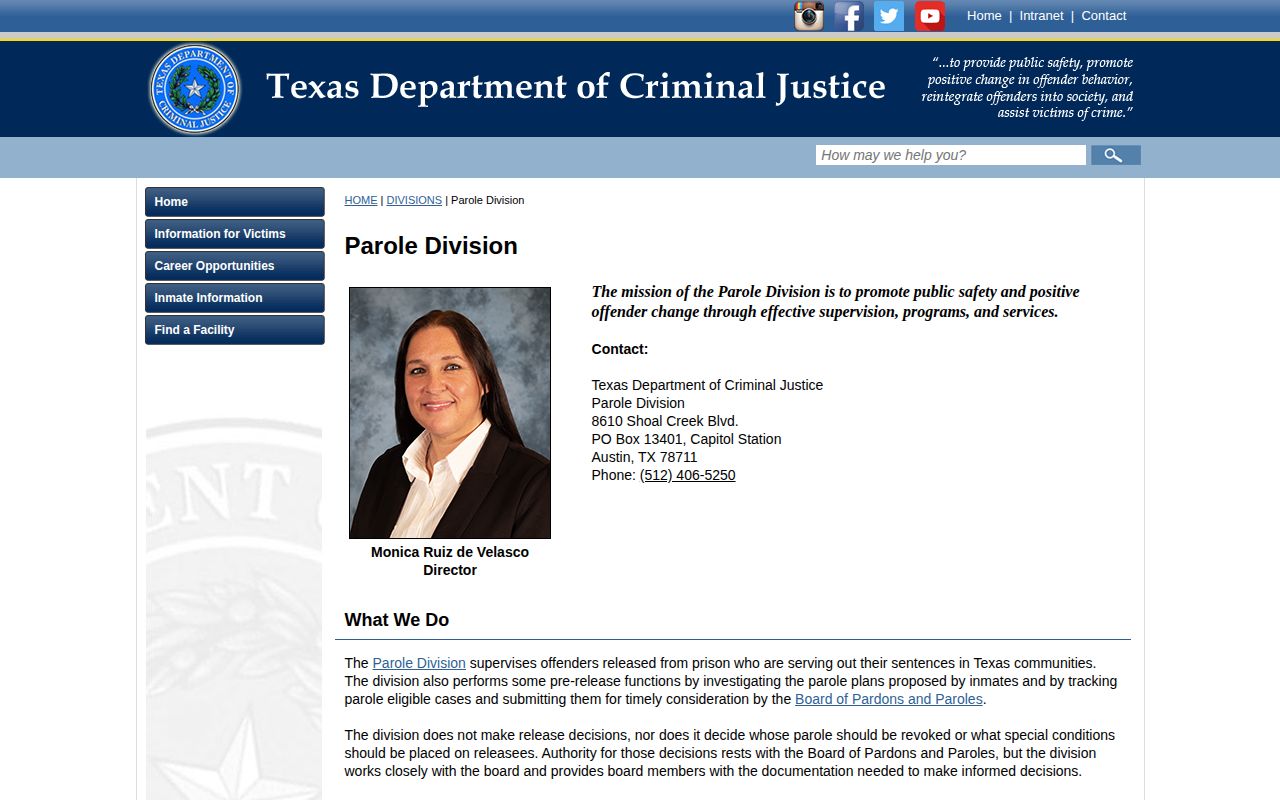
The agency page supports the state role shown above, while the Stephens County probation page identifies the separate local office.
Note: The county assignment is a starting point, but an approved residence change can place parole reporting with another district office.
Walker Sayle Release Preparation
Walker Sayle Unit creates a local state-release connection. The official Walker Sayle directory lists PRTC, CHANGES/Pre-Release, reentry, life skills, and several substance-use treatment tracks. Those services show that preparation exists at the unit. They do not show that a named person enrolled, finished a program, earned release, or received parole.
A person leaving Walker Sayle may transfer inside TDCJ, enter parole or mandatory supervision, or discharge at sentence completion. Each route has a different record. Search the TDCJ status and dates, then confirm through Parole Division if the result says “Under Supervision.” Direct discharge can explain why no parole office has an active file.
Program completion is not a release certificate. A unit description is broad facility information. A person's actual release date and status come from TDCJ records.
Stephens Parole Warrant Checks
Supervision conditions are rules attached to parole, mandatory supervision, or probation. They may address reporting, travel, treatment, monitoring, and compliance with agency or court directions. Precise terms come from the person's order or certificate. A violation allegation begins a process and is not a final finding.
TDCJ’s Warrants Section operates continuously and enters authorized warrants in NCIC and TCIC. Those are law-enforcement systems. Stephens County has no confirmed public parole-absconder list, so a stale web status or missed appointment must never become an accusation. Public contact is 8610 Shoal Creek Boulevard, Austin, TX 78757, at 512-406-5398.
A person held in Stephens County Jail on a parole warrant may appear on the county roster while TDCJ reflects an ongoing supervision action. Read both sources. “Blue warrant” is a common term for a Texas parole or mandatory-supervision warrant, but the actual authority comes from TDCJ and the hearing record.
Verify before labeling: Only an authorized record can establish a warrant or absconding status. A missing search result proves neither.
Stephens Supervision Discharge Records
Supervision ends through the controlling legal process. A parole or mandatory-supervision term may reach discharge under TDCJ authority. Probation ends through the court and CSCD process. Revocation can instead return the case to custody or prompt another Board or court decision. Read the public status with the discharge document when the exact end date matters.
For TDCJ, request the release or discharge record through the Office of General Counsel. Classification and Records handles calculation questions at 936-437-6231 or classify@tdcj.texas.gov. Records Management does not answer time, custody, transfer, or release questions.
For probation, ask the correct court clerk for the docket, judgment, supervision order, revocation order if any, and discharge or closing order. Later expunction under Chapter 55A or nondisclosure under Government Code Chapter 411, Subchapter E-1 is separate. Release or completion alone does not erase the case.
Leaving jail, beginning supervision, finishing supervision, and clearing a record are four distinct events. Each belongs to a different office and may occur on a different date.
Stephens Parole Decision Records
The Board and Parole Division also have separate roles. The Texas Board of Pardons and Paroles votes on release and revocation matters. Parole Division supervises a person after release and reports alleged violations. Neither office is the Stephens County Sheriff. A Board decision can therefore exist while the person remains in TDCJ for required processing, and a later county arrest can occur while the state sentence remains under supervision.
Board review status is available by telephone at 1-844-512-0461. The line can provide the current review stage, last decision and date, and next scheduled review. A favorable code must be read with its conditions. It does not replace the actual release date in TDCJ records. If the Board has not voted, parole eligibility means only that review may occur.
When Parole Division seeks revocation, Texas provides a process that can include notice, disclosure, a preliminary hearing when applicable, a revocation hearing, evidence and counsel-related rights, and a three-member panel decision. The exact path depends on the case. A jail booking or warrant entry alone does not reveal the final outcome. Ask for the Board or TDCJ record that states the decision.
Probation violations follow the sentencing court instead. The docket may show a motion to revoke, hearing, amended conditions, continuation, or revocation order. Contact the District Clerk for a felony or 90th District Court case and the County Clerk for a county-court misdemeanor. Matching the cause number avoids confusing the supervision case with a later booking.
Release notifications can supplement these records. TDCJ IVSS may offer notices about parole eligibility, Board action, bench-warrant movement, discharge, prison release, or post-release warrant action. Texas IVSS-Counties may offer county custody and court events if Stephens participates. A notice reports a sourced event. It does not explain every legal consequence.
Public Record Search
Sponsored Results